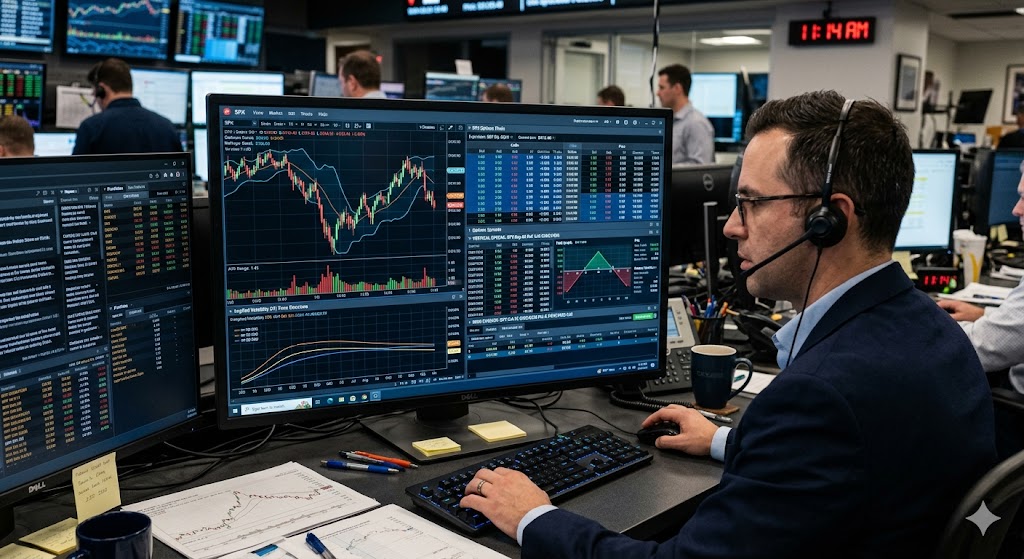

Derivatives trading allows investors to gain exposure to financial markets without directly owning the underlying asset. Instead of buying stocks, commodities, or currencies outright, traders use contracts whose value is tied to those assets.
While widely used in professional markets, derivatives trading can be complex and requires a clear understanding of both risks and mechanics.
What Derivatives Trading Means

A derivative is a financial contract whose value is based on an underlying asset such as:
- Stocks
- Commodities (oil, gold)
- Currencies
- Interest rates
- Market indexes
Instead of owning the asset, you are trading the price movement.
For example, a trader might enter a contract that profits if oil prices rise, without ever owning physical oil.
Types of Derivatives
Several types of derivatives are commonly used in financial markets.
Futures contracts
Agreements to buy or sell an asset at a predetermined price on a future date.
Options contracts
Provide the right—but not the obligation—to buy or sell an asset at a set price.
Swaps
Contracts where two parties exchange financial flows, often used by institutions.
Forwards
Customized agreements similar to futures but traded privately.
Each type serves different purposes, from speculation to risk management.
How Derivatives Trading Works
At its core, derivatives trading is based on price movement.
A simplified formula helps illustrate profit or loss:
Profit = (Exit\ Price – Entry\ Price) \times Contract\ Size
Depending on the contract:
- You may profit from rising prices (long position)
- Or profit from falling prices (short position)
Leverage is often involved, meaning you can control a large position with a relatively small amount of capital.
Benefits of Derivatives Trading

Derivatives offer flexibility that traditional investing does not.
Key advantages include:
- Ability to trade both rising and falling markets
- Use of leverage to amplify exposure
- Hedging against price risk
- Access to a wide range of asset classes
For example, a farmer might use futures contracts to lock in crop prices, reducing uncertainty.
Pro Insight
Leverage is a double-edged sword. While it can increase gains, it can also magnify losses quickly. Many experienced traders focus more on risk control than on maximizing returns.
Derivatives vs Spot Trading
| Feature | Derivatives Trading | Spot Trading |
|---|---|---|
| Ownership | No direct ownership | Direct ownership |
| Complexity | Higher | Lower |
| Leverage | Common | Rare |
| Risk level | Higher | Moderate |
| Use case | Hedging, speculation | Investing, trading |
This comparison highlights why derivatives are often used for more advanced strategies.
When Derivatives Trading Is Used
Derivatives are commonly used in several situations:
- Hedging risk in volatile markets
- Short-term speculation on price movements
- Managing large portfolios
- Accessing markets that are difficult to trade directly
A real-world scenario:
An airline company uses fuel futures to lock in prices. If fuel costs rise later, the contract helps offset higher expenses.
Quick Tip
Start with simple contracts and small position sizes. Understanding how derivatives behave in real market conditions is more valuable than jumping into complex strategies too quickly.
Risks You Should Know
Derivatives trading involves significant risks:
- Leverage can amplify losses
- Complex pricing structures
- Margin calls if positions move against you
- Rapid market changes can lead to unexpected outcomes
For example, a small price movement against a leveraged position can result in a large percentage loss.
Frequently Asked Questions

What is derivatives trading in simple terms
It involves trading contracts whose value is based on an underlying asset.
Is derivatives trading risky
Yes, especially due to leverage and market volatility.
Can beginners trade derivatives
They can, but it requires education and careful risk management.
Do you own the asset in derivatives trading
No, you are trading contracts linked to the asset.
What is the main purpose of derivatives
They are used for hedging risk or speculating on price movements.
Conclusion
Derivatives trading provides powerful tools for managing risk and gaining market exposure, but it comes with added complexity and higher risk. Understanding how contracts work, how leverage affects outcomes, and when to use these instruments is essential before getting started.
For many investors, derivatives serve as a complement to traditional investing rather than a replacement—offering flexibility when used with discipline and awareness.
Trusted U.S. Resources
https://www.investor.gov
https://www.sec.gov
https://www.finra.org
https://www.cftc.gov
This article is for general informational purposes only and does not provide legal, financial, medical, or professional advice. Policies, rates, and regulations may change over time.